Today we are disclosing another critical bug in the widely used @zodiaceco Roles Modifier Module with MultiSend unwrapping for @safe wallets.
A reminder again that modules are used by Safe owners to expand the functionality of a Safe, but these also have full access to execute transactions, send funds, etc. so great care must be given to ensure these modules are bug free.
This finding was in the repo:
https://github.com/gnosisguild/zodiac-modifier-roles
Team has acknowledged and fixed below and has been able to inform the majority of users to migrate to the updated version.
https://github.com/gnosisguild/zodiac-modifier-roles/commit/1ddde84db9024c6c1898d1f4cf5dabded3e824f1
The Zodiac Roles app now shows a warning for mods that are still on the vulnerable version of the multisend unwrapper and offers a one-click migration to the fixed version.
If you would like to engage our AI security services for your protocol visit scan.grego.ai or contact @0xriptide or @0xitsgreg
Bug report follows …
TLDR
A crafted MultiSend payload could circumvent permission checking and replace between 1 to 31 trailing bytes with zeroes. This is only possible for the last transaction and the last parameter in the multisend batch, so a function where a trailing parameter controls something critical. Attacker must already have a role assigned.
Summary
The MultiSendUnwrapper._validateEntries function uses data.length (which includes ABI encoding padding of up to 31 bytes) instead of the actual inner bytes boundary when bounds-checking entry data. This allows a crafted multisend entry’s data field to extend into the ABI padding zone, creating a mismatch between the calldata the Roles Modifier’s permission checker verifies and the calldata MultiSend actually executes. A role member can exploit this to bypass function parameter restrictions — for instance, making the permission checker approve a transfer to an allowed treasury address while MultiSend executes the transfer to address(0), permanently destroying the funds.
Impact
The vulnerability breaks the Roles Modifier’s core security guarantee: that only permission-checked operations are executed through the Safe. For functions where critical parameters (particularly recipient addresses) appear near the end of the calldata, the permission checker can be made to verify completely different values than what MultiSend executes.
An example would be permanent fund destruction via functions where the recipient address is a trailing parameter. For a function like Aave’s Pool.withdraw(address asset, uint256 amount, address to), the to address falls in the padding zone, causing the permission checker to see the approved recipient while MultiSend passes address(0). The withdrawn funds are sent to the zero address and permanently lost.
Description
The Zodiac Roles Modifier enforces fine-grained permission restrictions on what transactions a module can execute through a Gnosis Safe. When a module submits a batched MultiSend transaction, the MultiSendUnwrapper adapter parses the packed entries so each inner transaction can be individually permission-checked by PermissionChecker._multiEntrypoint. After all checks pass, the identical calldata is forwarded to the Safe, which delegate-calls MultiSend for execution.
The vulnerability arises because the unwrapper’s boundary check allows parsed entries to reference bytes beyond the actual packed transaction content, into the ABI encoding padding zone, where the permission checker reads attacker-controlled values from calldata but MultiSend reads zeros from memory.
The multiSend calldata layout
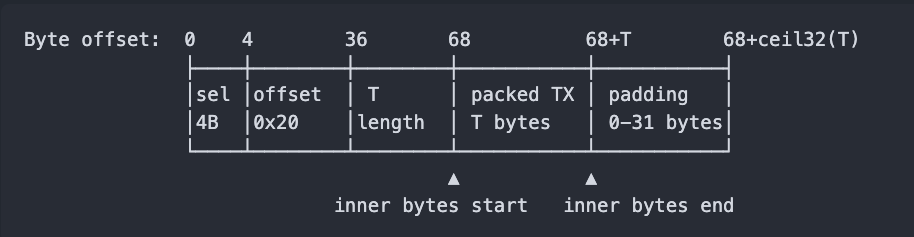
The bug
_validateHeader correctly reads the inner bytes length T at line 43 and validates that data.length == 4 + ceil32(64 + T). But T is a local variable and is never passed to _validateEntries:
// MultiSendUnwrapper.sol — _validateHeader
uint256 length = uint256(bytes32(data[36:])); // T is read here
if (4 + _ceil32(32 + 32 + length) != data.length) {
    revert MalformedHeader();
}
_validateEntries uses data.length as its boundary instead of 68 + T:
// MultiSendUnwrapper.sol — _validateEntries (line 72)
uint256 length = uint256(bytes32(data[offset + 53:]));
if (offset + 85 + length > data.length) {  // BUG: uses data.length, not 68 + T
    revert MalformedBody();
}
The devs recognized the padding issue for the loop termination (line 58: “data is padded to 32 bytes we can’t simply do offset < data.length”) but did not apply the same reasoning to the entry data bounds check.
The mismatch
When (64 + T) % 32 != 0, up to 31 bytes of ABI padding exist between the inner bytes boundary (68 + T) and data.length. An entry can declare a dataLength that extends into this padding zone. The result:

The same data is used for both _authorize and exec in Roles.sol (lines 109–117), with no intermediate re-validation.
Recommended Fix
Pass the inner bytes boundary 68 + T from _validateHeader to _validateEntries and use it in the bounds check:
function unwrap(...) external pure returns (UnwrappedTransaction[] memory) {
    // ...
    uint256 innerEnd = _validateHeader(data);
    uint256 count = _validateEntries(data, innerEnd);
    return _unwrapEntries(data, count);
}

function _validateHeader(bytes calldata data) private pure returns (uint256 innerEnd) {
    // ... existing checks ...
    uint256 length = uint256(bytes32(data[36:]));
    if (4 + _ceil32(32 + 32 + length) != data.length) {
        revert MalformedHeader();
    }
    innerEnd = 68 + length;
}

function _validateEntries(bytes calldata data, uint256 innerEnd) private pure returns (uint256 count) {
    uint256 offset = OFFSET_START;
    for (; offset + 32 < innerEnd; ) {   // use innerEnd, not data.length
        // ...
        uint256 length = uint256(bytes32(data[offset + 53:]));
        if (offset + 85 + length > innerEnd) {  // use innerEnd, not data.length
            revert MalformedBody();
        }
        offset += 85 + length;
        count++;
    }
    if (count == 0) {
        revert MalformedBody();
    }
}